

Compost | August
On trying to be the Fool, some holiday snapshots from Northern Ireland, family history, flags and murals, wood piegons and St Columba, and my ongoing love affair with the ocean

Episode 8 of my monthly compost posts: a round up of life currently, some short pieces of life writing, my bird of the month, and a tarot card or reading for the month.
Tarot card of the month: The Fool
I want to be the Fool. I want to step confidently into the unknown, to embrace new beginnings, to trust that the world will be there to hold me and that things will inevitably all work out. Getting ready to go away on holiday is one of the things that makes it really, really clear to me that I am not that person. For a day or two before we leave, there’s an anxious knot in my belly that could, if you’re feeling generous, be described as butterflies. I can’t settle to anything. My mind is an unending scroll of things that need to be done before we go away, of things that might go wrong while we’re away and possible solutions to each and every one of those imagined scenarios. The silver lining of all these anxious thought spirals is that they make me very good at packing. Everything we could possibly need, plus some emergency back up options (spare pants, an extra set of batteries, a print out of the e-ticket for the ferry - just in case), all carefully loaded into the car boot and the roof box like some advanced form of 3D tetris.
But the Fool, not looking where they are going even when they’re walking so close to the edge of a cliff, carrying just a single small knapsack over their shoulder, I am not. I don’t trust myself enough. Or I don’t trust the Universe. I am often paralysed by self-doubt, dithering for hours (or days, or weeks) before I’m ready to take the first step into something new. I do it though, eventually - and sometimes it even works out.
We’re just back from a week’s holiday in Northern Ireland, an equal mix of camping and staying in Premier Inns (a budget hotel chain in the UK). We organised and booked the holiday seven days before it began, which is quite possibly the most Fool-like energy thing I have done this year. And it nearly broke me. I have vowed that never again will the start of the six week school summer holidays in mid-July find us without a plan - but M, my other half, reminds me that I make this vow every year and we haven’t managed it yet. I’m mostly resigned to repeating this pattern next year, but I have put a reminder in my phone for 1 May 2026 to book a summer holiday.
For all it was organised at the last minute, our week in Northern Ireland worked out almost perfectly, unfurling smoothly from day to day like a carefully planned out tour. This is probably why we keep finding ourselves starting the school summer holidays with no clear plans - because even though my nervous system hates it, it does generally always work out. The world is there to catch us, the road rises to meet us, the wind is always at our backs. If only I could learn to trust it.
Holiday Snapshots
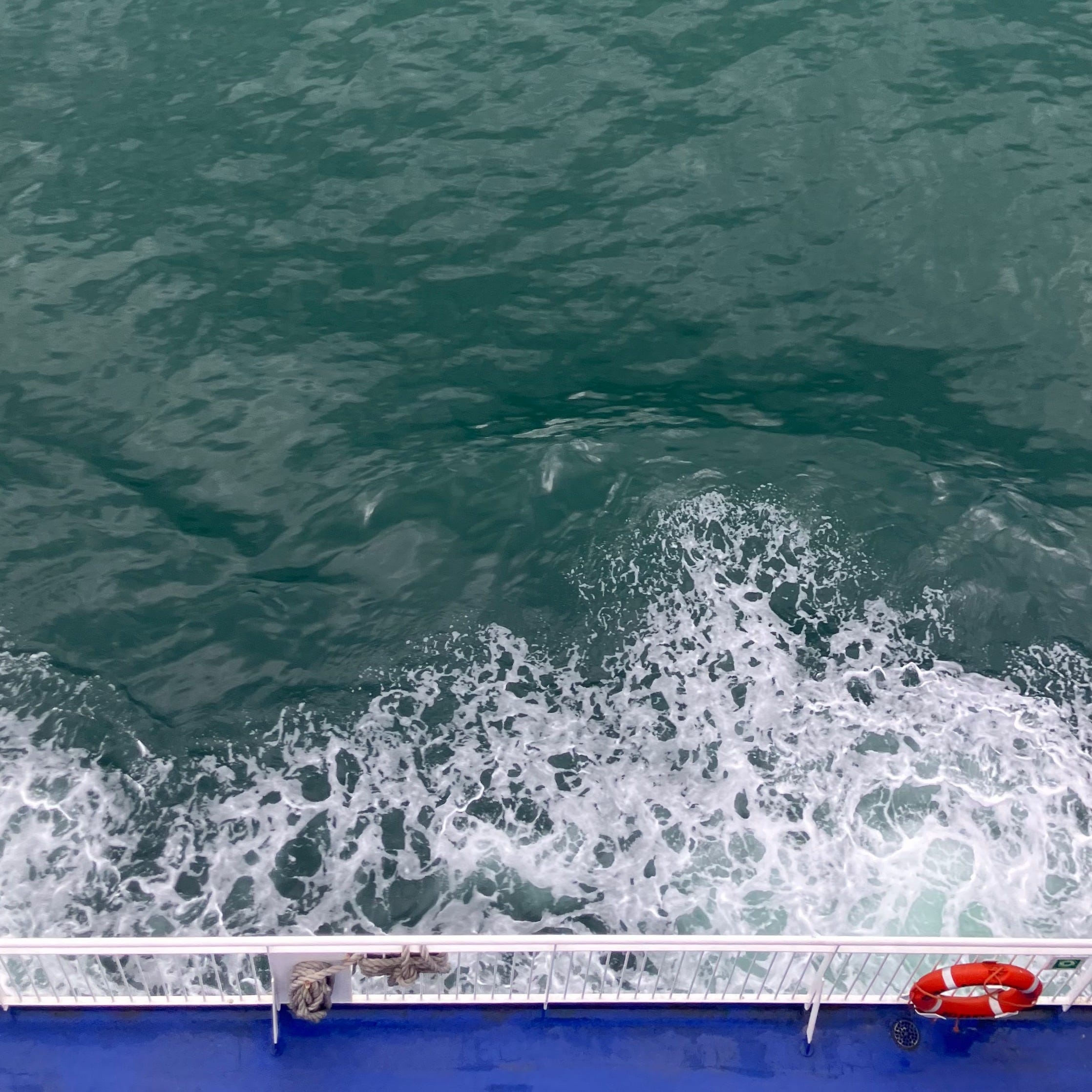
I surprised myself by not getting seasick on the ferry. I could have happily spent the whole crossing out on deck, watching the waves gliding past beneath us and the gannets swooping and diving, straining my eyes for a first glimpse of the Antrim coast. I grew up by the sea and I’m always happiest by the coast. Being surrounded by water on all sides was a delight - one usually marred by a queasy rocking feeling in my stomach and a need to go and lie down on one of the airport style benches inside the ferry.
Being by - or on - the sea gives me somewhere to put all my big feelings and big thoughts. I need that sense of space, that feeling of standing on the edge of the world and looking out over unimaginably long distances. I can feel hemmed in when I’m inland, with nowhere outside myself to put my feelings because everything around me is so full of stuff - layers of different lives (both human and non-human), layers of meaning, layers of time. The sea feels open and empty in comparison - though I know of course that it is not empty, that there are just as many layers of life and meaning and time, invisible beneath the waves.
Northern Ireland is M’s ancestral homeland on one side of his family tree. His great great grandparents emigrated from County Tyrone to Teesside via New York in the 1890s. We visited the tiny village where one branch of his family used to live, drove along the narrow lanes bordered by tall hawthorn hedgerows laden with ripening blackberries and dotted with crocosmia, walked around the crossroads studying the oldest buildings and trying to imagine the past lives of people who are mostly just names on a birth certificate or census return.
I love family history research and am itching to properly dig into M’s, particularly now we’ve visited some of the places his family once lived or may have passed through. It feels like way of commemorating your personal dead - discovering their names, mapping out their connections to you and trying to breathe an echo of life into those names on a page by finding out more about the places they lived, the jobs they did, the events that shaped their lives - both on a personal level and more widely.
It was, unsurprisingly, a week of flags and of murals. I have never seen as many Union Jacks in my life as I’ve seen in the past week. In Loyalist areas, a Union Jack or an Ulster flag fluttered from every lamppost and telegraph pole. In Republican areas the concentration of flags was less intense but the Irish tricolour, flying from a flagpole or hanging out of an upper window, clearly marked out the territory, often accompanied by a Palestinian flag. It was both surprising and heartening to see so much open and public support for Palestine in Northern Ireland, making me realise how circumspect much of that support has been in my area of North East England, outside of planned demonstrations and protests.
Murals were also everywhere in Belfast and Derry, the two big cities that we stayed in while we were there. We largely toured the murals in Republican areas - the Falls Road in Belfast and the Bogside in Derry. I was fascinated by the murals, both as art and as historical record - a community-based public record and commemoration of important people and events that perhaps didn’t always feature, or were misrepresented, in the ‘official’ narrative. Some murals are permanent, maintained and repainted as needed in order to preserve them, while others are temporary, painted over and replaced by new murals in response to current events. Many of the murals depicted people and events of the past, but the temporary, evolving nature of some of them made it clear they were a living tradition, rather than an inert form of heritage, long extinct but preserved in amber.


We visited the James Connolly Centre in Belfast (one of the leaders of the 1916 Easter Rising in Dublin) and the Free Derry Museum in Derry, and also watched Steve McQueen’s Grenfell film at the MAC in Belfast on our final morning. All three made me think a lot about narratives, and the ways that history is constructed by the winners. There are parallels between Bloody Sunday in Derry in 1972, when British soldiers shot and killed 14 unarmed peaceful civil rights marchers, and the Grenfell Fire in London in 2017, when 70 people died in a devastating fire in a residential tower block as a result of cascading acts of negligence by the architects, builders and local council specifically and by privatisation and capitalism more broadly. In the aftermath of both events, those in power (police, army, media) created a narrative to justify their actions or to avoid culpability. We can see the same thing happening after the Hillsborough disaster in 19891 and the Battle of Orgreave in 19842, and the same thing is happening today in the ongoing genocide that Israel is carrying out against Palestine.
Visiting Northern Ireland felt like a reminder that we can choose to look at history - and at current events - in a different way. We can disregard the ‘official’ version of events and listen to the accounts of the people who were - or are - there. British soldiers shot and killed unarmed peaceful demonstrators in the Bogside in 1972. Liverpool fans did not cause the fatal crowd crush at Hillsborough in 1989. Israel is carrying out a genocide in Gaza. It is important that the accounts of the people who directly experienced - or are directly experiencing - these manmade tragedies and deliberate killings are recorded and preserved, whether that’s in oral histories, murals on the sides of buildings, social media posts or another form. If only it didn’t seem to take a generation or so before we seem able to reject the previous constructed narrative and accept the first person accounts of those who were there as the truth.
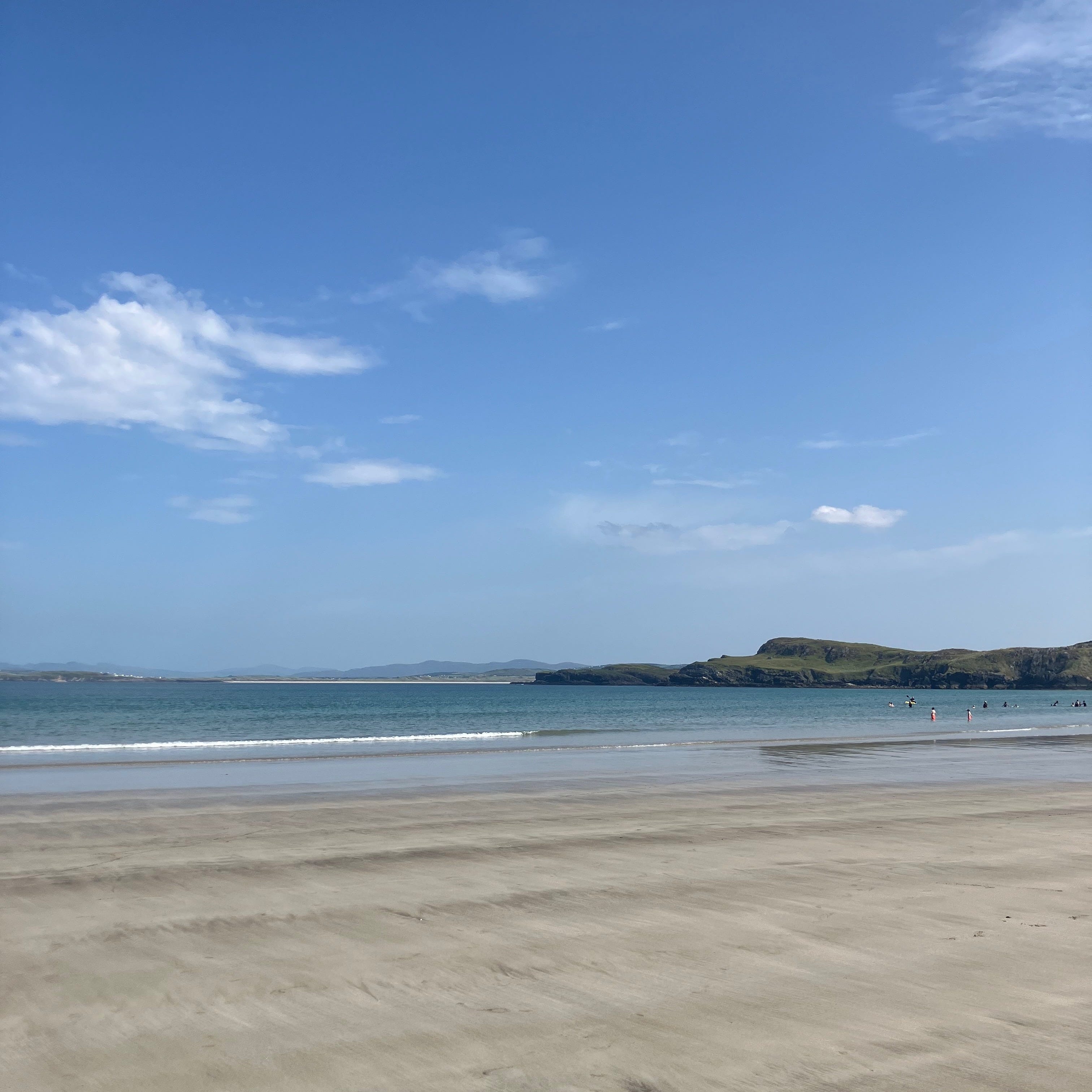
We also crossed the border into the Republic of Ireland, visiting the Donegal coast on one of the hottest days of the year. It felt slightly surreal to cross so easily into another country, the border marked by nothing more than the road signs suddenly changing and all the distances being in kilometres rather than miles. The children were also excited to spot green postboxes. There seemed to be an equal mix of ROI, Northern Irish and mainland UK cars on the roads, which was essentially one very long road that took us from the border just outside Derry all the way to the Atlantic coast.
I swam in the Atlantic Ocean, reigniting my desire to become a ‘proper’ wild swimmer rather than an occasional and opportunistic one. I also managed to swim without my usual minimum of 20 minutes standing hip deep in the water trying to psych myself up to take the plunge, so perhaps I am learning to embody a little more of that Fool energy in my 40s. It was a delight to bob about in the waves - helped of course by the hot and sunny weather. I swam or waded out until the water became too deep for me to touch the bottom, then turned and let the rising tide carry me back in. The feeling of weightlessness as each wave lifted me and hurried me forward felt like coming home, and I could have stayed out there for hours.
Bird of the Month: Wood Pigeon
Columba palumbus, Colomen Goed
For this month’s bird, I had to pick the wood pigeon, companion of my childhood camping holidays. I have layers of memories of waking up in my sleeping bag in the very early morning in a tent, and lying there listening to the wood pigeon’s looping call, letting it soothe me back to sleep. I’ve seen their call described as a ‘gruff, low-pitched growling’ but to me it’s softer than that. More of a purr than a growl, a content repetitive sound that tells me that all is right with the world.
I never saw a wood pigeon egg until we moved to our current house, which sits at the end of cul-de-sac and backs onto a small area of mature woodland - clearly prime wood pigeon habitat. Most years we regularly find empty shell fragments on the grass near our front garden gate and I’m never sure if they’ve fallen from a nest after a successful hatching or if the jackdaws that also roost close by have stolen the eggs to eat. I am always surprised by how small and how white wood pigeon eggs are - somehow I imagine something larger and duller. Trips to the garden are usually accompanied by the clattering of wood pigeon wings as they take suddenly take flight in alarm. It always sounds as if they’re struggling to get airborne, too shocked by our sudden appearance to remember how to fly.
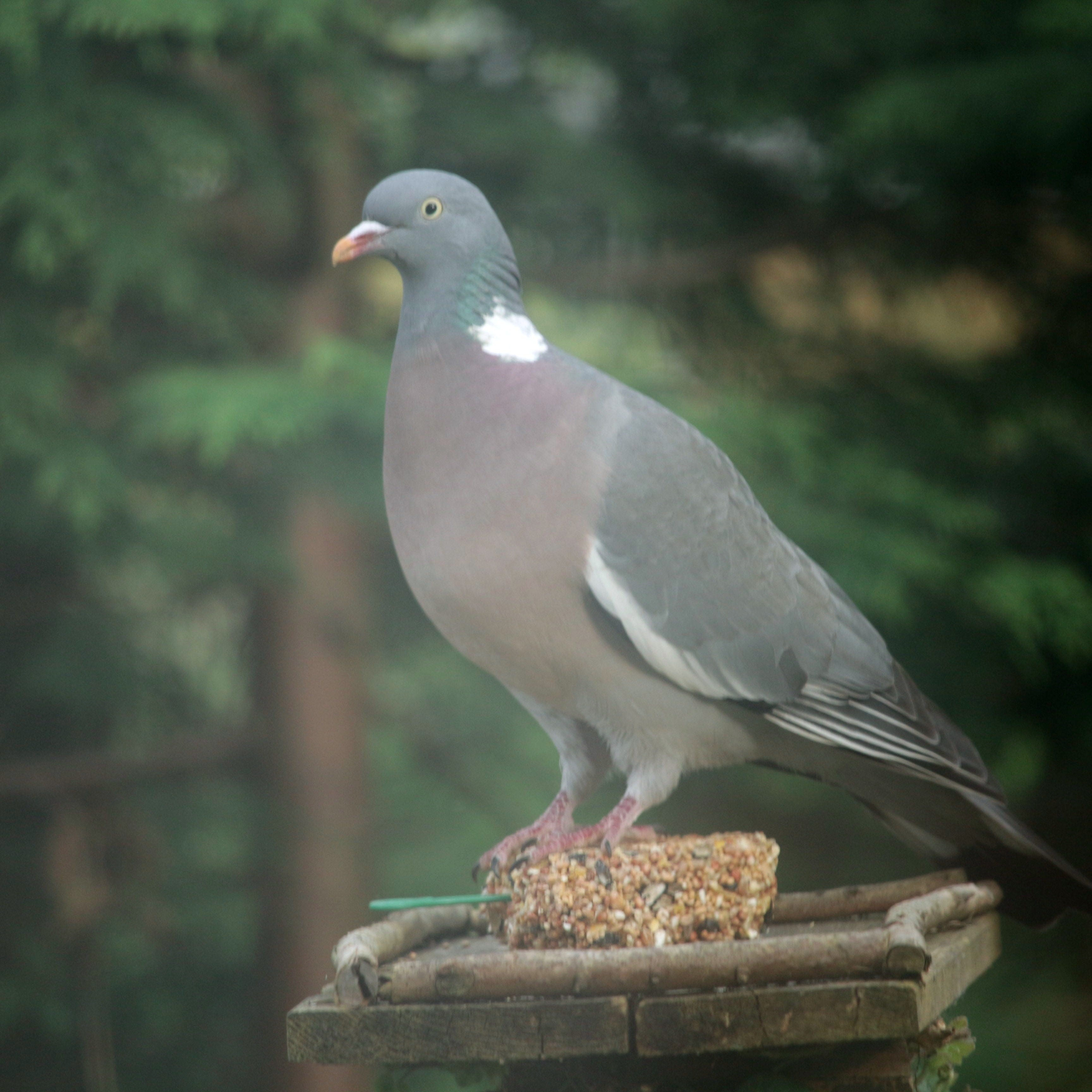
The wood pigeon is the largest and most common pigeon in the UK, a plump contented looking mostly grey bird with a patch of dusky rose pink feathers on its breast and a flash of turquoise on its neck. While we call it a pigeon in English, the first part of both its Latin and Welsh names (columba and colomen) means dove. A literal translation of its Welsh name would be ‘dove of the trees’. Its Latin name is also St Columba’s, patron saint of the city of Derry (as well as floods, bookbinders, poets, Ireland and Scotland, according to Wikipedia), which is a nice link back to our Northern Ireland holiday. In Irish, St Columba is Colmcille, or ‘dove of the church’. Columba was born in what is now County Donegal and founded a monastery in Derry before travelling to Scotland with twelve companions to found the famous monastery on Iona and convert the pagan Picts to Christianity.
97 Liverpool fans died and 766 were injured in a fatal crowd crush at Hillsborough Stadium in Sheffield in 1989 caused by a decision by the police to open an additional gate into the stands to attempt to ease crowding outside the stadium. South Yorkshire Police blamed the disaster on Liverpool fans, accusing them of being drunk and violent, as well as stealing from the dead and attacking emergency services staff in the aftermath.
The Battle of Orgreave was a violent confrontation between striking miners and police at a coke processing plant in South Yorkshire during the 1984-85 Miners’ Strike. Police officers on horseback made 4 mounted charges against the picketers, beating them with batons. 95 picketers were charged with riot or violent disorder, and the police narrative was that the picketers had attacked first, by throwing stones and other missiles.